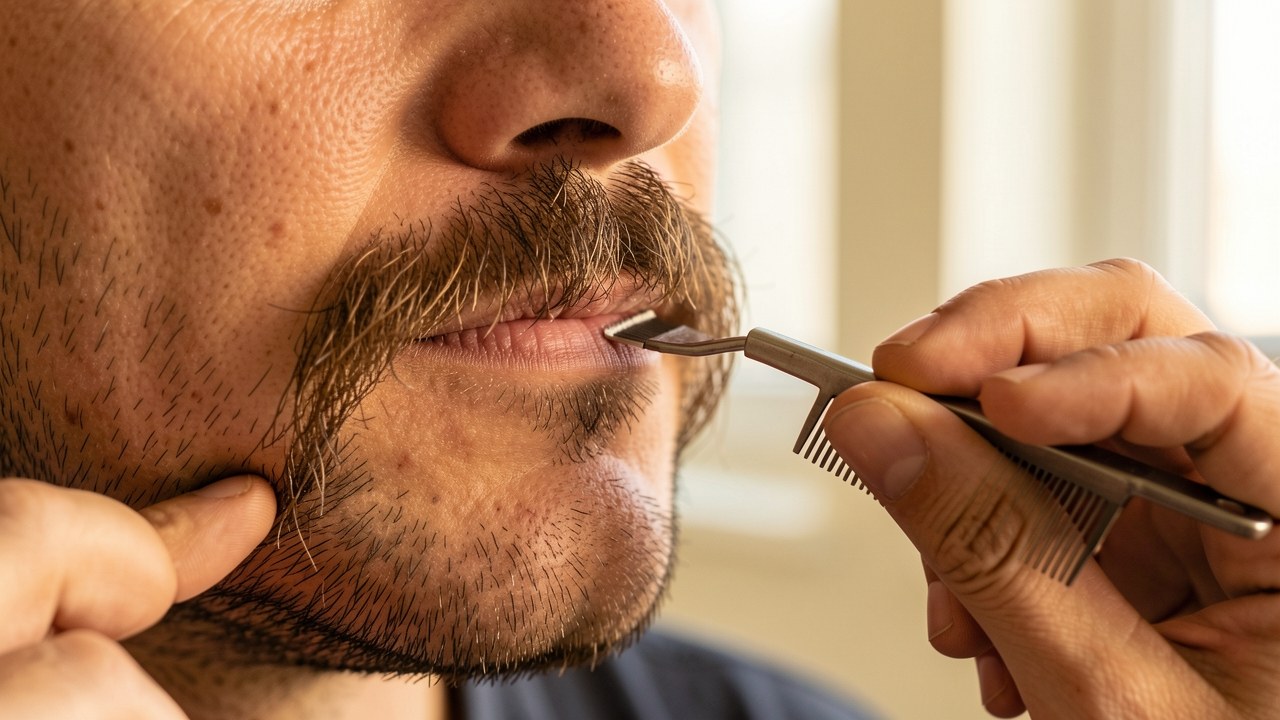
Choosing between moustache scissors and a trimmer
The tool you reach for shapes both the result and the margin for error. A beard trimmer with a guard removes bulk length quickly and evenly, and it lets you memorize a preferred guard setting for repeat trims. For detailed work, a trimmer's detailing head or a naked T-blade defines the perimeter and the area directly under the nose. Moustache scissors are the better choice when you want to lift hairs with a comb and snip them to a uniform length, or when you are working near the ends and want greater control over each cut. Small moustache scissors are preferred over general or office scissors because their smaller, sharper blades give greater control and reduce the risk of removing too much hair at once, and rounded tips help prevent cuts or pokes to the face.
- Beard trimmer with guard: fast, even bulk reduction; guard setting can be memorized.
- Trimmer detailing head or naked T-blade: clean perimeter lines and under-nose work.
- Moustache scissors with rounded tips: controlled snipping, especially with a comb.
- Moustache comb: detangles, distributes product evenly and helps train hairs to grow in a desired direction.
Sources: GQ, 18.21 Man Made
Preparing dry or damp hair and good lighting
Start with a clean face and a clean moustache. Wash the face, towel dry, and comb the moustache through with a fine-tooth comb. Give it a few minutes to dry fully before cutting. It is important to have dry hair when trimming because wet or damp hair behaves differently from dry hair, and hair expands when wet, which can cause you to cut off more than you intended. Good lighting matters as much as the tool: light the area from the front so you can see the natural fall of the hairs and any unevenness. Combing the moustache hairs downward reveals where the length falls, for example hair that reaches over the lip, and shows exactly where trimming is needed.
- Wash and towel dry the face and moustache.
- Comb through with a fine-tooth comb to remove tangles.
- Let the hair dry fully before cutting.
- Position yourself in front-facing light so shadows do not hide stray hairs.
Sources: GQ, 18.21 Man Made
Trimming the bulk length first
Remove length before you refine shape. Using a beard trimmer with a guard of your choice, work over the moustache to reduce the overall bulk evenly. Choose a guard setting and memorize the length that keeps your moustache at the size you prefer, so repeat trims stay consistent. If you do not have a trimmer, use a comb to lift the hairs and snip at them with moustache scissors to a uniform length. Work gradually rather than removing a large amount in one pass. A simple slip of the hand can remove too much hair and might even require starting from a bare face, so take it slow even if you trim once or twice a week.
- Comb the moustache downward to see the starting length.
- Fit your trimmer with the guard setting you have chosen.
- Trim the bulk evenly across the moustache, moving slowly.
- Check the length as you go; stop before you reach your final target.
- If using scissors instead, lift hairs with a comb and snip to a uniform length.
Sources: GQ, 18.21 Man Made
Shaping the lip line and edges
Once the bulk is reduced, define the moustache's perimeter. Use the detailing head or naked T-blade of a trimmer to clean the lines around the moustache, including directly under the nose. The lip line and the area around the philtrum stay clean when you trim the moustache above the top lip, and a razor can be used to touch up the top of the moustache until the desired line is reached. This edge cleanup may need attention a few times a week to manage stubble as it sprouts. If your goal is a handlebar or a slight end curl, leave the outermost hairs a bit longer than the inner stretch so there is enough length at the ends to style them upward with wax.
- Trim above the top lip and around the philtrum to keep the lip line clean.
- Use the trimmer's detail head or naked T-blade for under-nose and perimeter lines.
- Touch up with a razor for a sharper top line if needed.
- Leave the outermost hairs longer if you plan to curl or style the ends.
Sources: GQ, iloveindia.com lifestyle, Bossman Brands
Checking symmetry
After the initial trim, check both sides in a mirror under even light. One recommended method for symmetry is to work from the outside of the moustache in toward the center, then again from the opposite direction. This outside-in pass helps you match the two sides and blend the lengths across the center, rather than repeatedly trimming one side while the other stays longer. Step back from the mirror to view the moustache at a normal distance, then move closer to check for stray or uneven hairs. Small adjustments are easier to correct than large ones, so trim incrementally and recheck after each pass.
- Comb the moustache into its natural direction.
- Trim from the outside of one side toward the center.
- Repeat from the opposite side toward the center.
- Compare both sides at a distance in the mirror.
- Blend any noticeable steps with small snips; recheck before finishing.
Sources: GQ
Cleaning tools and aftercare
After trimming, comb the moustache once more to settle the hairs, and shape it with wax if you want to hold a particular look. Clean your tools before storing them: remove loose hair from the trimmer head and scissors, and keep blades dry to help them stay sharp. Dull tools are one of the common trimming mistakes to avoid. Other mistakes include cutting too much at once, trimming wet hair, cutting hair that still has heavy products or oils in it, and rushing the process. Trimming roughly every one to two weeks, or every seven to fourteen days, helps most moustaches keep a clean, intentional shape. That range is a general maintenance interval rather than a rule, and your own growth rate and style goals will guide the exact timing.
- Comb the moustache again and apply wax if you want hold.
- Remove loose hair from tools and keep blades dry.
- Avoid dull tools, cutting wet hair, and cutting hair with heavy product in it.
- A general maintenance range is every one to two weeks, adjusted to your growth.
Sources: GQ, 18.21 Man Made, Maestro's Classic, iloveindia.com lifestyle
Frequently asked questions
Should I trim a moustache wet or dry?
Trim it dry. Hair expands when wet, which can cause you to cut off more than you intended, and the better-supported grooming guidance is to wash and towel dry the face, comb the moustache through, and let it dry fully before trimming. Dry hair also behaves more predictably under scissors and trimmer.
Sources: GQ, 18.21 Man MadeHow do I avoid trimming too short?
Work gradually and take it slow. Remove bulk first with a guard, checking length as you go, and stop before you reach your final target so you can make small adjustments. A slip of the hand can remove too much hair and might even require starting from a bare face. Avoid cutting wet hair and cutting hair that still has heavy products or oils in it, and use sharp tools rather than dull ones.
Sources: GQ, 18.21 Man MadeHow often should a moustache be trimmed?
A general maintenance range is every one to two weeks, or every seven to fourteen days, to keep a clean shape. That is a practical interval rather than a rule; your growth rate and the style you want will guide how often you actually need to trim. Edge cleanup around the lip line and under the nose may need attention a few times a week to manage stubble.
Sources: GQ, Maestro's ClassicCan I use a beard trimmer on a moustache?
Yes. A beard trimmer with a guard is commonly used to remove bulk length evenly, and you can memorize the guard setting that keeps your moustache at your preferred length for repeat trims. The detailing head or a naked T-blade on the trimmer is useful for cleaning the perimeter and the area directly under the nose. If you do not have a trimmer, a comb and moustache scissors can achieve a uniform length instead.
Sources: GQ, 18.21 Man MadeSources
- How to Trim Your Mustache for Maximum Handsome | GQ — GQ
- How to Groom a Mustache – A Guide to Trimming and Shaping — 18.21 Man Made
- When to Trim Your Mustache and Simple Grooming Guide — Maestro's Classic
- How To Trim Your Moustache - Trimming A Mustache — iloveindia.com lifestyle
- Mustache Styles: The Ultimate Guide on How to Style Your Mustache — Bossman Brands