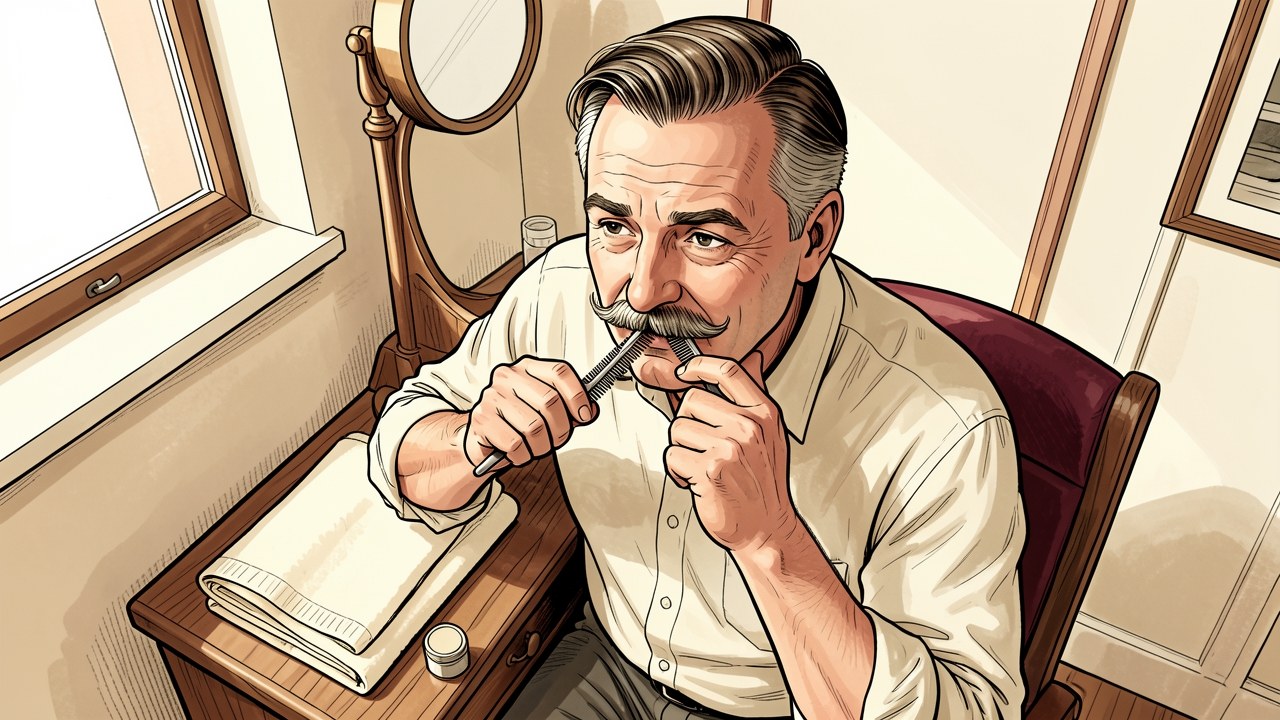
What a moustache is and how it grows
A moustache is the facial hair that grows on the upper lip. It can be worn on its own or grown to complement a beard, and it is one part of the wider subject of facial hair grooming. A well-groomed moustache needs deliberate maintenance rather than being left unattended; the same care routine that keeps a beard tidy applies to the hair above the lip.
Growth is personal. The pattern, colour, thickness and length of a moustache often differ from what a man pictures in advance, and not every man can grow a full handlebar moustache. Facial hair can also turn out darker, lighter, redder or greyer than the hair on the head, which is normal variation rather than a problem to fix.
Because growth rates differ from person to person, the useful skill is reading your own hair rather than chasing a fixed schedule. If you are starting a moustache, it helps to have some idea of the style you want while staying flexible enough to try a few alternatives as the hair takes shape.
- A moustache sits on the upper lip and can stand alone or pair with a beard.
- Colour, density and length vary between men and often differ from head hair.
- Not every growth pattern supports every style, including a full handlebar.
- Expectation-setting beats forcing a shape that your hair will not hold.
Sources: Live Bearded, Manhattan Barber Spa
Why moustache care belongs in a daily routine
Moustache hair is facial hair, and facial hair behaves differently from the hair on your head. Washing it too often strips natural oils, which can lead to dryness and irritation, while skipping moisturiser can leave dry, flaky skin underneath. That combination is why the moustache belongs in the same routine as beard and skin care rather than being treated as an afterthought.
A simple rhythm works better than occasional deep cleaning. Washing about two to three times per week is a commonly given routine frequency, and beard oil applied daily moisturises both the hair and the skin beneath it and helps prevent dryness and itchiness. Conditioning with a beard conditioner or balm softens the hair and makes it less prone to breakage.
Consistency matters more than intensity. Daily habits such as combing and conditioning between trims help keep facial hair looking its best, and a regular trimming schedule based on how quickly your hair grows helps keep the shape neat.
- Overwashing removes natural oils and can cause dryness and irritation.
- Moisturising addresses the skin under the hair, not just the hair itself.
- Daily combing and conditioning maintain the result between trims.
Sources: Manhattan Barber Spa, Woodward Barbers
Core routine at a glance: wash, trim, style, skin care
The core routine has four jobs: clean the hair without stripping it, trim it gradually, style it without overloading product, and care for the skin underneath. The order below is a sensible default for a weekly session, with light daily steps in between.
- Wash. Clean facial hair about two to three times per week rather than every day. Regular shampoo formulated for head hair can be too harsh for facial hair, so beard-specific products are usually recommended instead.
- Dry completely before trimming. Wet hair appears longer, so trimming damp hair can remove more than intended.
- Comb in the direction of growth, then trim in that same direction. Trimming against the grain can cause irritation, ingrown hairs and an uneven, patchy result.
- Trim gradually. Work in small passes with frequent checks in the mirror, because hair cannot be put back once it is removed.
- Style with a light touch. A small amount of moustache wax holds the shape; using too much can make the moustache look fake.
- Moisturise. Beard oil applied daily moisturises the hair and the skin beneath it and helps prevent dryness and itchiness.
- Brush. A boar bristle brush helps distribute natural oils through the hair.
- Condition. A beard conditioner or balm softens facial hair and makes it less prone to breakage.
- Maintain the neckline. Regular shaping keeps the overall look deliberate, and shaving too high on the neckline is a common mistake.
Sources: Manhattan Barber Spa, Woodward Barbers, Bossman Brands
How often to trim, wash and maintain
Trim intervals depend on the individual and on the style being worn, so treat these figures as ranges rather than rules. If the goal is to grow facial hair out, trimming about every four weeks is a commonly given interval; if the goal is to keep the current length, about every week is commonly given. A general maintenance schedule of every one to two weeks suits most people, and a weekly check-in is recommended for keeping a styled moustache tidy.
Hair grows at different rates, so waiting too long between trims can leave the moustache unruly and the beard losing its shape. Regular small trims are easier to live with than a drastic correction later.
Washing advice is similarly individual. Washing two to three times per week is a common recommendation, and overwashing is a recognised mistake because it strips oils. Start from that baseline and adjust to how your skin and hair respond.
- Growing out: about every four weeks, as commonly given.
- Holding length: about every week, as commonly given.
- General maintenance: every one to two weeks suits most people.
- Styled moustache: a weekly check-in keeps the shape tidy.
- Washing: about two to three times per week is a common starting point.
Sources: Manhattan Barber Spa, Woodward Barbers, Live Bearded
Choosing a style direction without product hype
Style names come from grooming guides rather than from any official standards body, so treat the categories below as practical descriptions rather than competition classifications. The table compares four commonly described directions using the characteristics those guides attribute to each.
The honest constraint is suitability. Forcing a moustache into a shape such as a handlebar without regard to facial structure, hair type, upper-lip width or hair fullness can lead to frustration, and a full handlebar is not achievable for every man. Choosing a direction that matches your actual growth is more satisfying than fighting it.
| Style | What it looks like | Hair type it suits | Effort to maintain |
|---|---|---|---|
| Chevron | Thick and full, worn until it brushes the top of the upper lip, trimmed into a neat line along the upper cheek and mouth. | Works best with straight hair; can make coarse hair look neat. | Moderate: grown out, then trimmed along the cheek and mouth lines. |
| Handlebar | Grown past the upper lip, parted over the middle of the lip with wax and a comb, with ends curled or twisted upward. | Not every man can grow a full handlebar; requires growth suited to that shape. | High: relies on wax, daily combing out to each side, twisting the ends up and out, and possibly a blow dryer. |
| Walrus | Bushy, overhanging and long, grown until it hangs over the edge of the lower lip, with the centre trimmed into a horseshoe shape. | Described as a big, bold look that works with a short or long beard. | High: needs length plus styling with wax, a comb and a blow dryer. |
| Pencil | Thin and narrowed, cut above the lip, parted down the middle and trimmed to a consistent thickness. | Not specified in the guides reviewed here. | High: requires careful styling and must be kept even. |
Sources: Bossman Brands, Manhattan Barber Spa, Live Bearded
Training hair to grow the way you want
A moustache can be trained to grow in a desired direction by combing the hairs that way daily. This is the least glamorous part of grooming and the one that most reliably changes how a moustache behaves over time.
For a handlebar, one described technique is to comb the hairs out to each side daily with moustache wax, using the right hand for the right side and the left hand for the left side, and to twist the hairs in a snapping motion between the thumb and forefinger. A blow dryer can help train difficult hairs to lie in a new direction, with the heat following your fingers as you twist the hair.
Styling detail matters as the moustache lengthens. The ends can be curled upward using the thumb and index finger, but the hair should not be twisted. A blow dryer can also give the moustache volume and make it easier to style, with a cool-air setting used to set the wax into the finished shape.
- Comb daily in the direction you want the hair to lie.
- Wax holds more elaborate shapes such as a handlebar.
- A blow dryer helps stubborn hairs change direction and adds volume.
- Curl longer ends with thumb and forefinger; do not twist the hair.
Sources: Bossman Brands, Live Bearded, Manhattan Barber Spa
how to avoid them
Most moustache problems come from a short list of avoidable habits. The fixes are simple, and each one addresses a specific cause rather than a general lack of effort.
One recurring theme is the beard-moustache transition. Where a moustache meets a beard, the ends of the moustache can be carefully tapered so the two flow together, or a defined line can be kept clean and sharp. Neglecting that area shows, no matter how well the rest is trimmed.
Another is tooling. Trimming tools should be sharp, clean and designed for facial hair, and should be oiled or sharpened to keep them performing. Dull, unsuitable or unclean tools produce uneven cuts and irritation.
- Washing too often: strips natural oils and causes dryness and irritation.
- Skipping moisturiser: leads to dry, flaky skin under the hair.
- Trimming damp hair: wet hair looks longer, so more comes off than intended.
- Trimming against the grain: can cause irritation, ingrown hairs and a patchy result.
- Big single cuts: trim in small passes and check often, because hair does not grow back instantly.
- Dull or dirty tools: keep blades sharp, clean and made for facial hair.
- Shaving too high on the neckline: undermines the overall shape of the facial hair.
- Forcing a style: matching the style to your growth beats fighting it.
- Uneven sides: bring both sides as close to even as possible without repeatedly going back and forth, which risks cutting shorter than you want.
- Ignoring nose hairs: hairs that spill into the moustache are part of the picture.
Sources: Manhattan Barber Spa, Woodward Barbers, Live Bearded, The Beard Struggle
Where to go next in this guide
This page is the overview. Each sub-guide goes deeper on one part of the routine, so you can move from understanding to doing without reading everything at once.
If you want technique, start with moustache grooming and facial hair care. If you are still deciding on a shape, browse moustache styles. For the rest of the routine, the skin care, hair care and fragrance guides cover the surrounding habits, and the tools page explains what the equipment is for.
If you want to know how this site decides what to publish, the about page and the editorial policy explain the approach.
- Moustache grooming for step-by-step technique.
- Moustache styles for choosing a direction.
- Facial hair care for beard and moustache maintenance together.
- Skin care, hair care and fragrance for the wider routine.
- Tools for the equipment each step uses.
- About and editorial policy for how the guides are put together.
Sources: Manhattan Barber Spa, Woodward Barbers, Live Bearded
Frequently asked questions
How long does it take to grow a full moustache?
There is no single reliable figure, because growth rate, density and pattern vary from man to man, and the moustache you can grow depends on your own facial hair. Rather than working to a fixed timeline, expect variation: your moustache may come in darker, lighter, redder or greyer than your head hair, and not every man can grow a full handlebar. The practical approach is to let the hair grow while checking the shape regularly, and to choose a style that suits the growth you actually have.
Sources: Manhattan Barber SpaShould I trim my moustache wet or dry?
Trim it dry. Wet hair appears longer than it is, so trimming damp hair can remove more than you intended. After washing, dry the facial hair completely before you start trimming.
Sources: Woodward BarbersDo I need special products for moustache care?
Not a large kit. Regular shampoo formulated for head hair can be too harsh for facial hair, so beard-specific products are usually recommended instead. For hold and shape, moustache wax is used for more elaborate styles such as a handlebar; apply it with a light touch, because too much can make the moustache look fake. Daily beard oil moisturises the hair and the skin beneath it, a beard conditioner or balm softens the hair and reduces breakage, and a boar bristle brush helps distribute natural oils when you brush.
Sources: Manhattan Barber Spa, Bossman BrandsCan moustache grooming help with itch or flakes?
Grooming habits can reduce the dryness that contributes to itchiness and flaking. Skipping moisturiser is a known cause of dry, flaky skin under facial hair, and beard oil applied daily moisturises both the hair and the skin beneath it and helps prevent dryness and itchiness. Washing too often strips natural oils, which can also lead to dryness and irritation, so about two to three times per week is a common starting frequency. If you have persistent itch, flaking, redness or soreness, that is a skin concern rather than a styling problem, and a qualified healthcare professional is the right person to assess it.
Sources: Manhattan Barber SpaHow often should I trim my moustache?
It depends on your growth and the style you wear. Commonly given intervals include about every four weeks when growing facial hair out, about every week when keeping the current length, and every one to two weeks as general maintenance for most people. For a styled moustache, a weekly check-in is recommended to keep the shape tidy. Waiting too long can leave the moustache unruly and the beard losing its shape, so pick the interval that matches how fast your hair grows.
Sources: Manhattan Barber Spa, Woodward Barbers, Live BeardedHow do I keep both sides of my moustache even?
Bring the two sides as close to even as possible, but do not keep going back and forth between them. The face is generally not perfectly symmetrical, and repeated correcting risks cutting the moustache shorter than you wanted. Trim in small passes with frequent checks in the mirror, and accept minor asymmetry rather than chasing a mirror-perfect match.
Sources: Live Bearded, Woodward BarbersCan I train my moustache to grow in a particular direction?
Yes. Combing the hairs in the direction you want them to lie, done daily, is the standard way to train a moustache. A blow dryer can help stubborn hairs change direction, with the heat following your fingers as you twist the hair, and a cool-air setting can set wax into the finished shape. For a handlebar, the described technique is to comb the hairs out to each side daily with moustache wax, using the right hand for the right side and the left hand for the left side, and to twist the hairs in a snapping motion between thumb and forefinger.
Sources: Bossman Brands, Live BeardedSources
- Mustache Styles: The Ultimate Guide on How to Style Your Mustache — Bossman Brands
- Beard and Mustache Care Tips — Manhattan Barber Spa
- 7 Mistakes You Need to Avoid When Trimming Moustache & Beard — Woodward Barbers
- Top 3 Grooming Tips You Must Know to Avoid Mustache Mistakes! — Live Bearded
- How to Trim a Military Mustache: Precision and Discipline — The Beard Struggle